

Painting
How I Paint on a Cake (Without It Turning Muddy)
A painter's guide to painting on fondant and buttercream — the surface prep, the alcohol-to-colour ratio, and the four mistakes that make painted cakes look muddy.
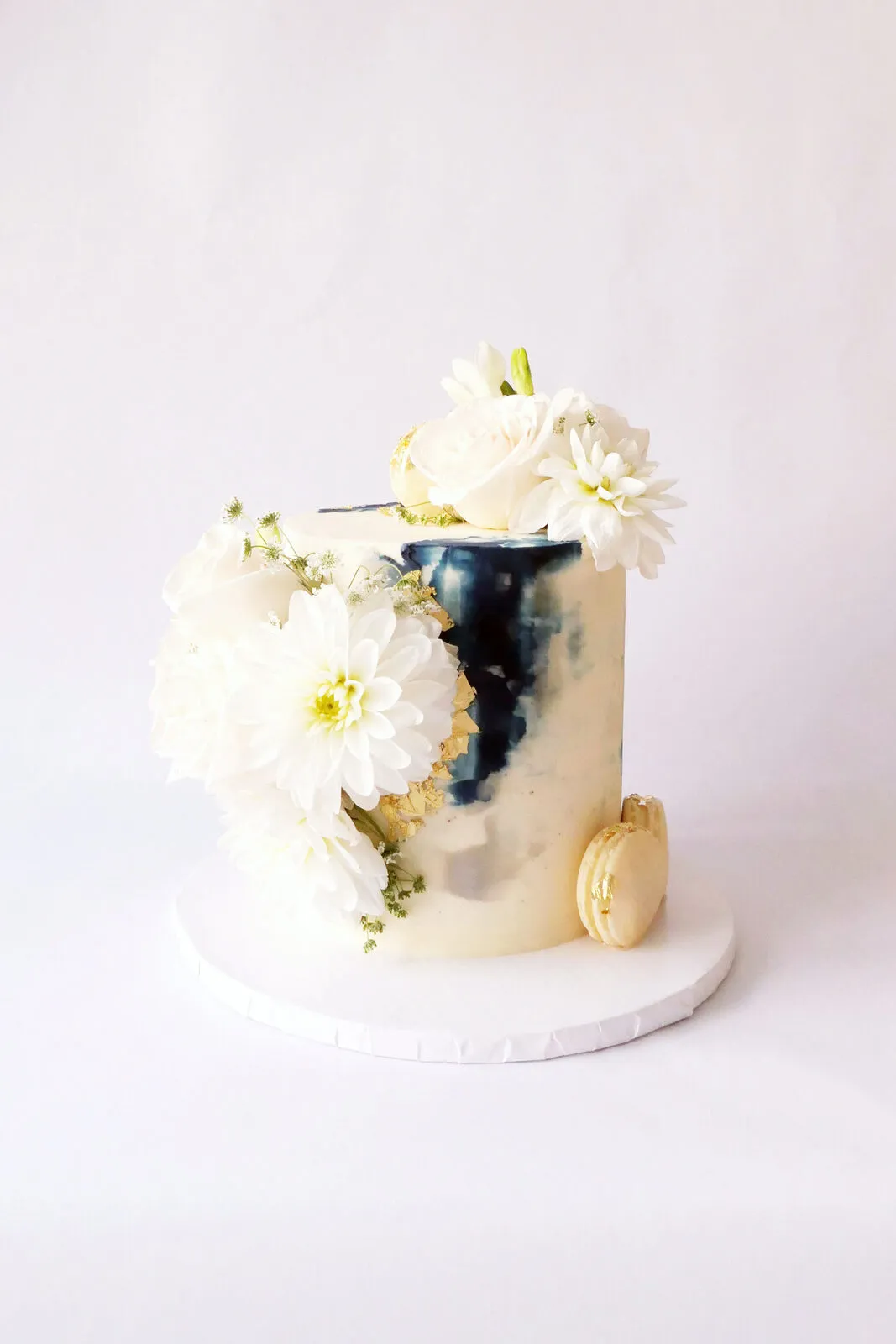
Most people’s first painted cake looks muddy. The colours go on bright, then within a minute they’ve gone grey at the edges, the brush is dragging, and the whole thing looks like a watercolour left in the rain.
It’s almost never a talent problem. It’s a surface and a water problem, and both are fixable.
I came to cake from painting — I grew up drawing and painting long before I ever picked up a piping bag, and when I found cake I basically found a new canvas. What follows is what I wish someone had told me in the first year.
What painting on a cake actually means
You are not using water. That’s the first thing.
Cake painting uses pigment thinned with alcohol — usually a clear, high-proof spirit like vodka, or a clear alcohol-based extract. The alcohol carries the colour onto the surface and then evaporates fast, leaving pigment behind. Water doesn’t evaporate fast enough; it sits on the surface, dissolves the sugar underneath, and that dissolved sugar is what turns your colours muddy and your surface tacky.
Two pigment options:
- Gel colours — concentrated, vivid, good for saturated work. Thin them heavily.
- Petal or lustre dusts — mixed to a paste with alcohol. Softer, more opaque, better for layered and blended work.
The surface matters more than the paint
This is where most painted cakes are lost before the first brushstroke.
On fondant: the fondant needs to be set. Freshly applied fondant is soft and slightly damp, and a wet brush will pit it. Give it time to firm up and form a dry skin.
On buttercream: the surface has to be properly chilled and firm, or crusted if you’re using a crusting recipe. A soft buttercream surface will lift and smear the instant a brush touches it. Chill it hard, work in short sessions, and put it back in the fridge the moment it starts to give.
Buttercream is genuinely harder to paint than fondant. If this is your first attempt, start on fondant.
What you need
- Fine detail brushes in a few sizes, kept only for food use
- A palette — a ceramic tile, a plastic palette, anything non-porous
- Clear high-proof alcohol or clear extract
- Gel colours and/or petal dusts
- Paper towel for blotting
- A small dish of alcohol for rinsing
That’s the whole kit. Painting is one of the cheapest cake techniques to start.
The process
1. Sketch first, lightly. Plan the shape before any colour goes down.
2. Mix thin. Far more alcohol than you think. Start almost transparent — you can always build up, but you cannot take pigment off.
3. Blot your brush every time. Load, then touch it to paper towel before it touches the cake. A loaded brush drops too much liquid in one spot, and that spot is where the surface starts dissolving.
4. Build in layers, letting each dry. This is the whole secret. Thin transparent layers stacked up read as rich and deep. One thick layer reads as muddy. It’s the same logic as watercolour.
5. Details last, at full strength. Fine lines and the darkest accents go on at the end, on a dry surface.
Four reasons your painting looks muddy
You used water. See above. Alcohol only.
Your layers weren’t dry. Painting into a wet layer lifts the pigment underneath and mixes it into the new colour. Grey is what you get when everything mixes. Wait longer than feels necessary.
Too much liquid on the brush. The surface dissolves, the sugar goes into your paint, and the colour goes cloudy. Blot every time.
You mixed complementary colours by accident. Layering a green over a red, or an orange over a blue, gives you brown — even when neither colour looked brown on the palette. Think about what’s already on the cake before you put the next colour down.
Fondant vs buttercream, honestly
| Fondant | Buttercream | |
|---|---|---|
| Forgiveness | Higher — mistakes can often be lifted | Low — a mistake usually means starting the panel over |
| Surface prep | Let it set and skin over | Chill hard, work cold |
| Detail possible | Very fine | Softer, more limited |
| Best for | Beginners, detailed work | Loose, painterly work; clients who won’t eat fondant |
Is the alcohol safe?
Yes. The volume is tiny and it evaporates almost entirely before serving. If you’d rather avoid it — for a dry household, or for a children’s cake — clear alcohol-based extracts work the same way, and there are alcohol-free food-safe alternatives sold for this purpose.
Common questions
- Do I use water to paint on a cake?
- No. Use a clear, high-proof alcohol such as vodka, or a clear alcohol-based extract. Alcohol evaporates fast and leaves the pigment behind. Water sits on the surface, dissolves the sugar underneath, and that dissolved sugar is what turns your colours muddy.
- Can I paint on buttercream, or only fondant?
- Both work, but buttercream is harder. The surface has to be properly chilled and firm, or crusted if you are using a crusting recipe. A soft buttercream surface will lift and smear the moment a brush touches it. If it is your first attempt, start on fondant.
- Is the alcohol safe to serve?
- Yes. The volume is tiny and almost all of it evaporates before the cake is served. If you would rather avoid it, clear alcohol-based extracts work the same way, and there are alcohol-free food-safe alternatives sold for this purpose.
- Why do my colours go grey?
- Usually one of four reasons: you used water, your layers were not dry before you painted over them, there was too much liquid on the brush, or you layered complementary colours over one another without meaning to.
Read next
-
Fondant or Buttercream?
How each finish looks, how each one tastes, and which suits the cake you are imagining — written for anyone about to order a custom cake.
-
Choosing Your Cake Size
What a serving count actually means once the cake is cut, how to plan for leftovers, and how to decide between one tier and two.
Based in Toronto and after a cake rather than a lesson? Order a cake